No fuzz theory for music students.
The overwhelming music theory. A whole world of chords and hertz, frequencies, devilish intervals, progressions, cadences and who knows what. But the truth is, we don’t need to know everything.
Sure, if you want to be a composer, there will be a lot of that, but you still won’t learn it all in your freshman classes. And the chances are high that you’re a self-taught musician looking to dive a little deeper into theory, since you’re here at www.musicforyourlessons.com , where we provide exactly such things as resources and tools for the student and self-taught.
So without any more chitchat, let’s dive right into it!
1. Tones and Semi-tones
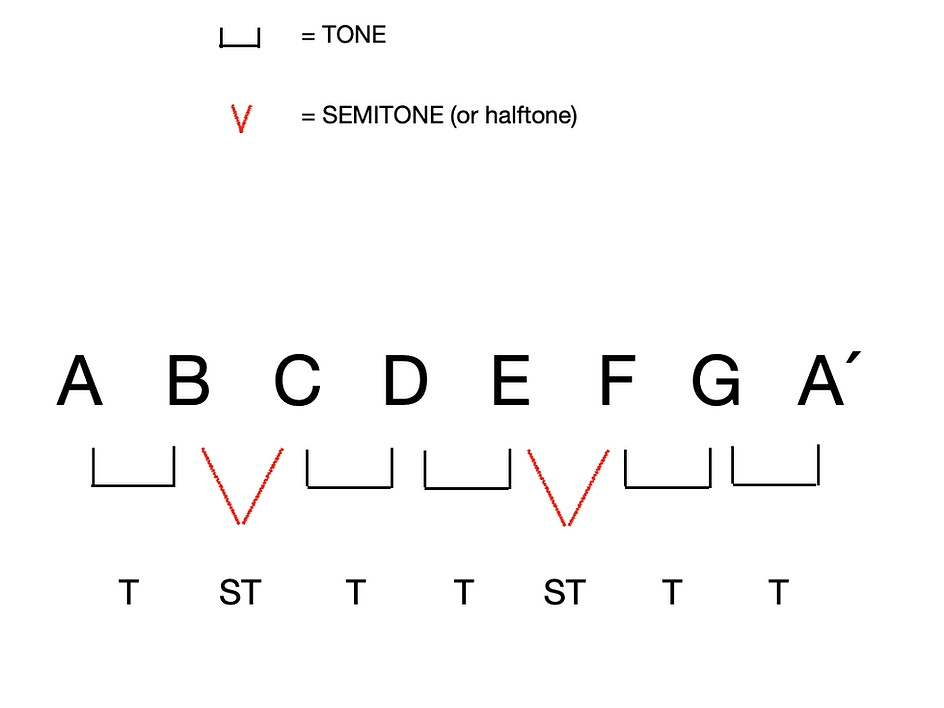
Music is math. Everything can be measured and represented with numbers. Sorry if that’s a party killer! The good news is that it is doable and easy to learn. For those of you who play any stringed instrument (think guitar frets) or keys, I’m sure you’ve noticed that some notes “feel together” but are further apart (physically, in distance) than others. That’s because a scale is made of 12 semitones (or halftones), and that two semitones make… you guessed it, one tone. Some notes are a semitone apart, and some notes are a tone apart. This is what it looks like:
Why is this important?
This will be very helpful when learning scales (since all of them follow the same pattern) and for improvisation as well.
Tip! A fret = a semitone
Fun fact: the “high A´” vibrates at exactly twice the frequency (Hz) than
the lower A. Therefore sounds similar, but higher,and has the same name.
(440Hz – 880Hz)
2. Intervals and Chords
This is where the fancy words begin… but it doesn’t have to be that complicated. It actually means the same thing, which is the distance between notes. It also tells how it should be played: the notes can sound together, at the same time. Normally when they are written they are done so vertically, one on top of the other. This is a chord. A chord is made of at least two notes that are played at the same time. But the notes can also appear one after the other, as in a melody. This is written horizontally, or one next to the other. This is an interval.
Why is this important?
When playing more advanced melodies or chords, you may hear something like “with the 6th added”. So it´s important to know how to calculate that distance. Here some examples:
An interval of a 4th: C (jump to) F
A chord with the 6th added: C Major chord + A on top of it (all played at the same time).
3. Types of chords
If you’re a guitarist or keyboardist who plays more modern stuff, you may have stumbled upon chords. They have the same name as the previous notes (A, B, C, …) plus some elaborated surnames such as Major, minor, perfect, augmented or diminished.
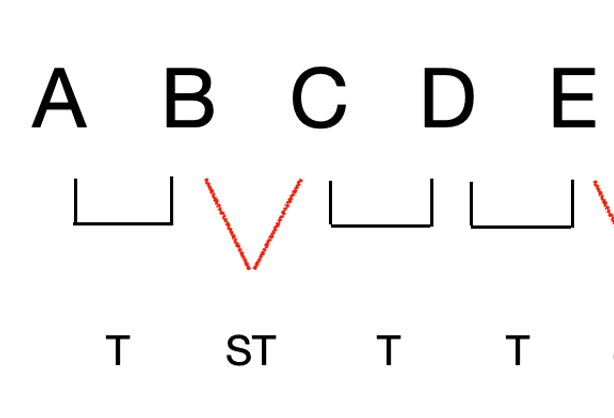
If you look at the image of “Tones and semitones” you will see that the distance between A and C is three notes (or an interval of 3rd, we always count from the first one), and it is made of a Tone + a semitone. But again, if you take the same distance from C to E, it will be a 3rd interval again, but this time made of 2 tones. This is because A-C is smaller (minor third or 3m) and C-E is larger (major third or 3M). So the “surname of the chords” just shows the distances between the notes they are made of (again a chord is two or more notes play at the same time). More of this in the next chapters!
Why is this important?
Different chords sound different, and this is very important to know when learning new shapes or positions on your guitar, or when writing a song.
– Tip! We have a full chord chart for piano and guitar at our website. –
4. Pulse, beat and rhythm
Just like a clock, every piece of music has a constant pace to it, that shows how fast or slow a song is. Think of a heartbeat: It is steady and constant. So that would be the pulse or beat. Every piece of music has a beat, and it´s the speed or reference upon the song is composed on. The rhythm is more intricate. The rhythm is actually the combination of long and short notes, that combined make a pattern. A clear example of this is “We Will Rock You” by Queen, when the band claps short-short-long, or as I like to call it, “cof-fee tea!” (c´mon clap it now!) . This is not a steady single-pulse but as said before, a combination of shorts and longs to make a pattern. This is the rhythm. If still confused take a look at our video!
Why is this important?
The beat: To play with others or with a song. It is essential to locate the beat and know where in the song you are. It is what is called timing (or metronome), and all the musicians in the band must follow it. It’s also the reference for the whole song, so if the beat is played correctly, we can place the notes and beats on top of it, in relation to it, and therefore learn the rhythm.
This is all for now! Next blog we will talk about time signatures, scales and will go deep into the chords. Leave your ideas on the comments below so we can include them as well! 🙂
Rocío Martínez,
Founder and teacher at Music For Your Lessons.
 Music For Your Lessons
Leave a comment